Feast day: August 24
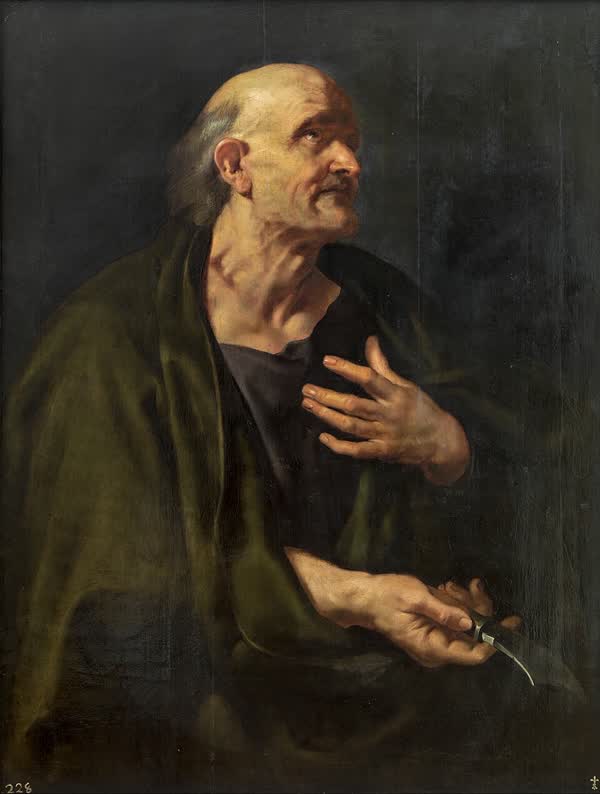
St. Bartholomew
The apostle identified with Nathanael, of whom Jesus said 'Behold, an Israelite in whom there is no guile'; by tradition martyred in Armenia.
Bartholomew was one of the twelve apostles, named in all the lists of the Twelve, yet about whom the Gospels otherwise say nothing directly. For this reason he is very widely identified with Nathanael, the man from Cana whom the Gospel of John describes Philip bringing to Jesus — the Israelite 'in whom there is no guile,' who greeted Jesus with the confession, 'You are the Son of God, the King of Israel.'
If that identification is right, Bartholomew was a thoughtful, straightforward man, at first skeptical — 'Can anything good come out of Nazareth?' — but quickly won over when Jesus showed that he had seen him, unseen, beneath a fig tree. After the Resurrection he is named among the apostles to whom the risen Christ appeared by the Sea of Galilee.
Of his later mission, tradition speaks with one voice that he carried the Gospel far to the east — through Mesopotamia and Persia and, above all, into Armenia, where he is honoured, with St. Jude, as a founder of the Armenian Church.
Tradition holds that he was martyred in Armenia, and the most common account — that he was flayed alive before being beheaded — gave rise to his gruesome emblem, a flaying knife, and to his patronage of tanners and leatherworkers. Michelangelo painted him in the Sistine Chapel holding his own flayed skin.
His brutal martyrdom (flayed alive, by tradition) is why Michelangelo painted him in the Sistine Chapel holding his own skin — with Michelangelo's face on it.
“Rabbi, you are the Son of God; you are the King of Israel. (as Nathanael)”
— St. Bartholomew
Image: Peter Paul Rubens (Public domain), via Wikimedia Commons.
Source: newadvent.org/cathen/02313c.htm
Get a story like this every Sunday.