Feast day: July 11
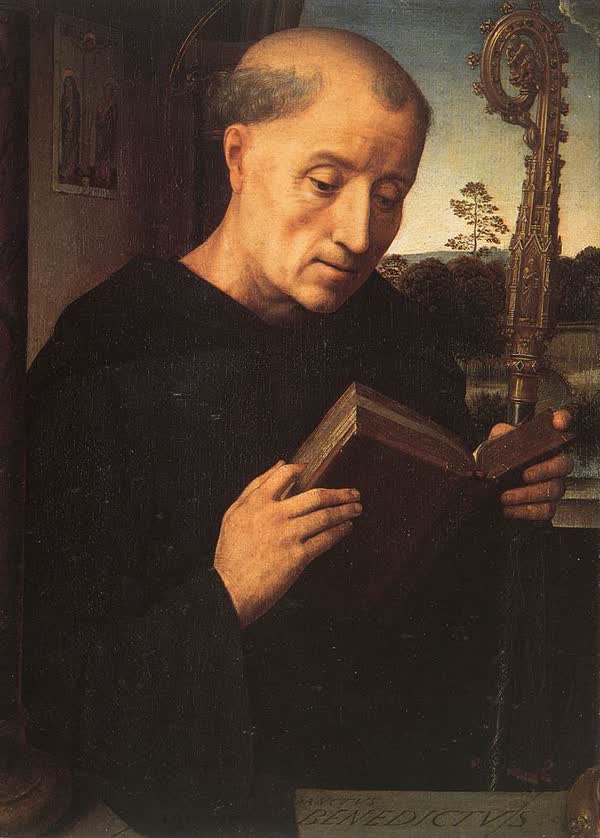
St. Benedict of Nursia
Roman student who fled the city's decadence for a cave, then wrote the Rule that organized Western monasticism — and quietly saved Western civilization.
Benedict was born around 480 at Nursia in central Italy and sent as a young man to study in Rome, but he was so repelled by the licentiousness of the city that he fled it to seek God alone. He withdrew to a cave at Subiaco, where he lived as a hermit for three years, supplied with food by a monk who lowered it down the cliff, slowly mastering himself in solitude and prayer.
His holiness drew followers, and Benedict organized them into communities — eventually twelve small monasteries of twelve monks each. Opposition and even an attempt to poison him drove him at last to Monte Cassino, the mountain between Rome and Naples where, by tradition, he overturned the last pagan altar and founded the monastery that would become the cradle of Western monasticism.
There he wrote his Rule, a short, wise, and humane guide to community life under an abbot, balanced between prayer, sacred reading, and manual work — 'pray and work.' Free of the extreme harshness of earlier monasticism, it emphasized stability, moderation, and obedience, and was so well judged that it gradually became the standard for monks throughout the West; thousands of abbeys would live by it.
Benedict died at Monte Cassino around 547, and his monks carried his Rule across Europe in the centuries that followed, becoming the great preservers of learning and faith through the Dark Ages. For shaping the monasticism that civilized a continent, he was named a patron of Europe, and his medal and motto remain a sign of protection for Christians everywhere.
His monasteries copied the books, kept the schools, and farmed the land through the Dark Ages. 'Ora et labora' — pray and work — rebuilt Europe.
“Prefer nothing whatever to Christ.”
— St. Benedict of Nursia
Image: Hans Memling (Public domain), via Wikimedia Commons.
Source: newadvent.org/cathen/02467b.htm
Get a story like this every Sunday.
← The Seven Holy Brothers · All saints · Sts. Louis & Zélie Martin →