Feast day: February 3
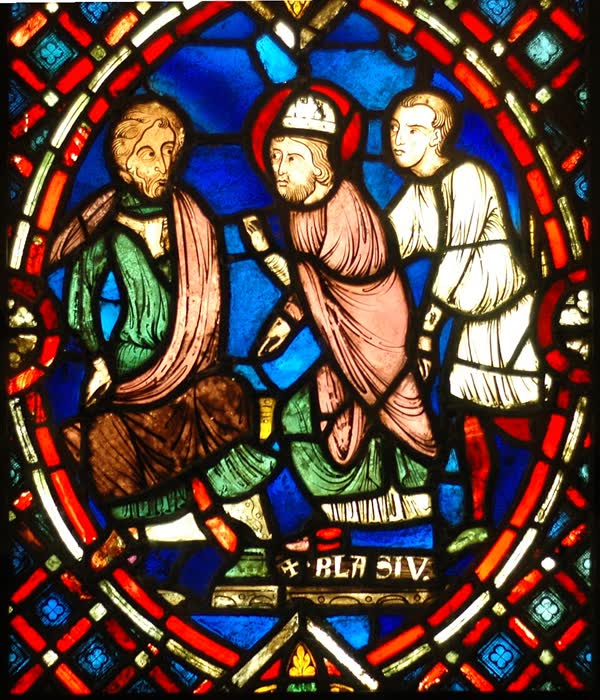
St. Blaise
Armenian bishop and physician martyred under Licinius; en route to prison he healed a boy choking on a fishbone.
Blaise was bishop of Sebaste in Armenia in the early fourth century, and by tradition a physician before he was a bishop — a healer of both bodies and souls. Little can be established of his life with certainty, but he became one of the most popular saints of the Middle Ages, invoked across Europe and counted among the Fourteen Holy Helpers, the saints called upon in times of sickness and danger.
The legends tell that during the persecution under the Emperor Licinius he withdrew to a cave on a mountain, where he lived as a hermit and the wild animals came to him gently to be healed and blessed. When the hunters of the governor found him, they discovered him surrounded by these beasts, and arrested him.
On the way to prison occurred the miracle for which he is best remembered: a distraught mother brought to him her little boy, who was choking to death on a fishbone lodged in his throat, and Blaise healed the child. From this story he became the patron invoked against diseases of the throat and all who suffer there.
He was cruelly tortured — his flesh torn, the tradition says, with the iron combs used for carding wool, which made him also a patron of wool-workers — and then beheaded, about the year 316. On his feast, February 3, the Church still gives the 'blessing of throats,' touching the throat of each of the faithful with two crossed candles and praying that, through his intercession, they be preserved from every ailment of the throat and every other evil.
Catholics still get their throats blessed with crossed candles every February 3 — a tradition over a thousand years old.
Image: Unknown artistUnknown artist (Public domain), via Wikimedia Commons.
Source: newadvent.org/cathen/02592a.htm
Get a story like this every Sunday.
← The Presentation of the Lord · All saints · St. John de Britto →