Feast day: October 6
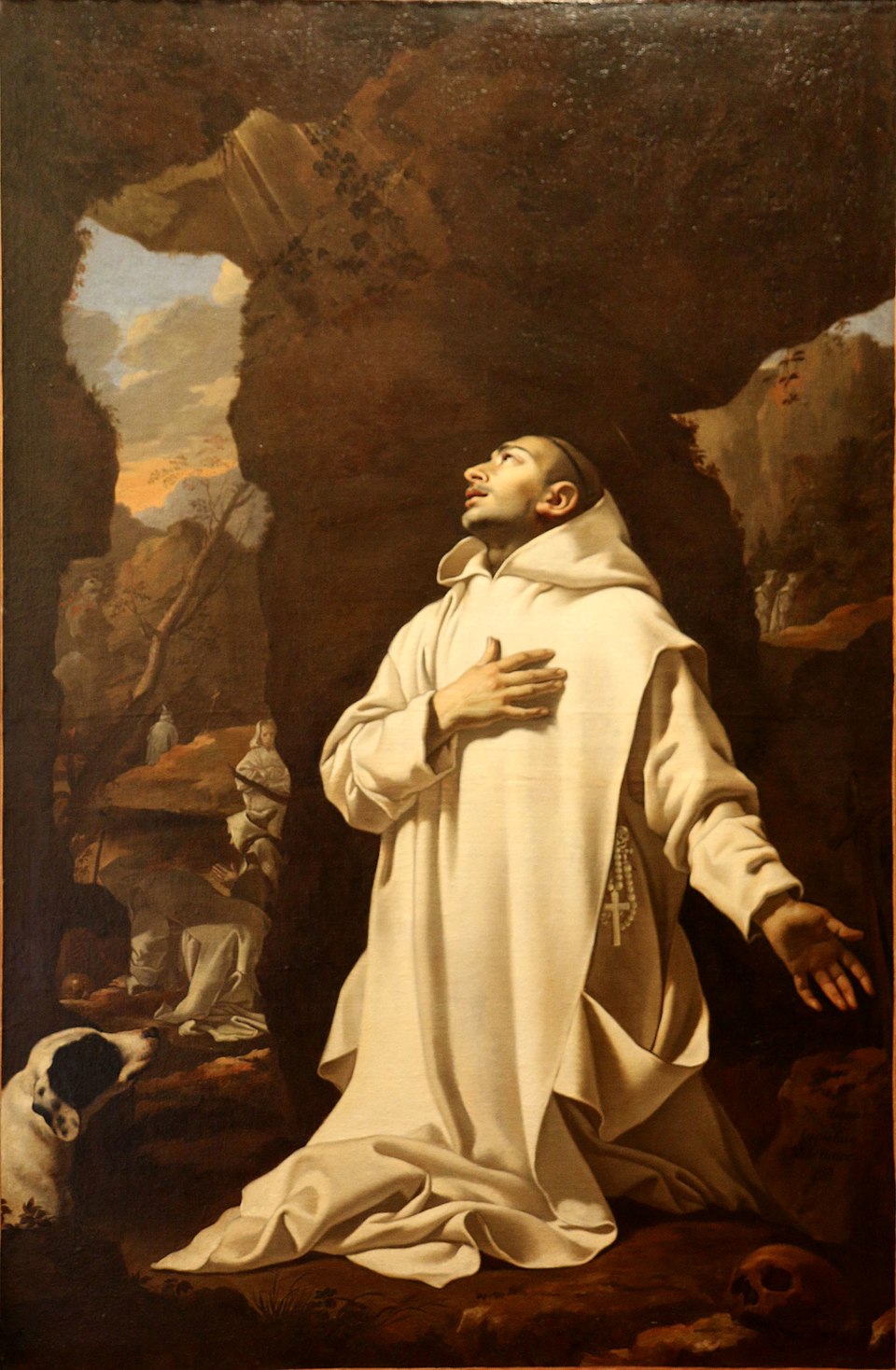
St. Bruno
A renowned teacher of Cologne and Reims who, longing for solitude, withdrew with companions into the alpine wilderness of the Chartreuse and founded the silent Carthusian order.
Bruno was born about 1030 at Cologne, in Germany, and became one of the most distinguished scholars and teachers of his age, head of the renowned cathedral school of Reims, where he trained future bishops and at least one future pope. He seemed destined for high office in the Church — but a longing for solitude and a horror at the worldliness and corruption of the clergy turned him another way.
After a famous episode that deepened his disgust with worldly ambition, he renounced his prospects and, with a few companions, sought out a life of utter withdrawal. In 1084, with the help of the bishop of Grenoble, he settled in a remote, rugged Alpine valley called the Chartreuse, high in the mountains, to live in silence, poverty, and prayer.
There he founded what became the Carthusian Order — the most austere of all Western religious orders — whose monks live as hermits in separate cells, gathering only for certain prayers, devoted to silence and contemplation. The order took its name from that first valley: the Grande Chartreuse, mother-house of the Carthusians to this day.
Called away briefly to Rome to advise the pope, Bruno begged to return to solitude and founded a second hermitage in the mountains of Calabria, in southern Italy, where he died in 1101. He left no written rule, but the order he began has kept his contemplative ideal, almost unchanged, for nine centuries.
He founded the strictest order in the Western Church — hermits living in silence and solitude — and the Carthusians, almost uniquely, have never needed reform.
Image: Nicolas Mignard (Public domain), via Wikimedia Commons.
Source: newadvent.org/cathen/03014b.htm
Get a story like this every Sunday.
← St. Faustina Kowalska · All saints · Our Lady of the Rosary →