Feast day: April 29
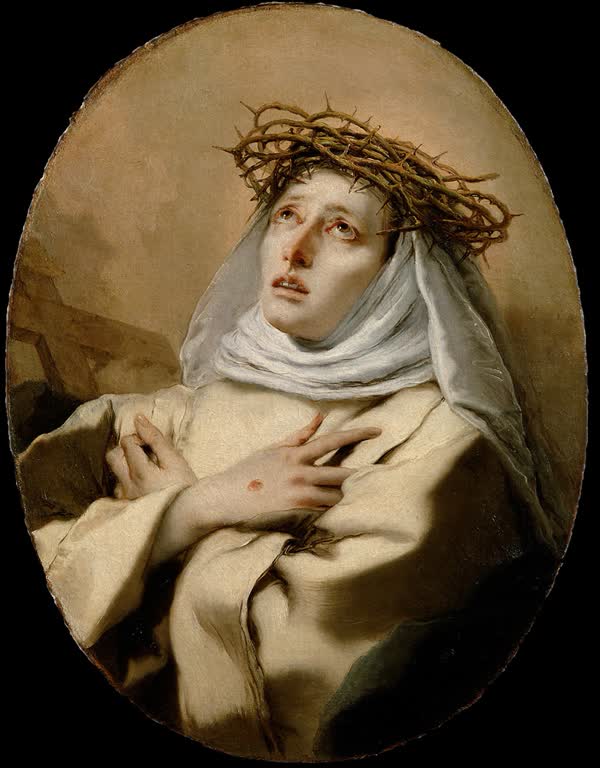
St. Catherine of Siena
A dyer's daughter, 24th of 25 children, who never learned to write until adulthood — and ended up counseling popes and brokering peace between cities.
Catherine was born at Siena in 1347, the twenty-fourth or twenty-fifth child of a cloth-dyer's large family. From early childhood she saw visions and practiced severe penances, and at about sixteen, resisting her family's wish that she marry, she took the habit of the Dominican Tertiaries — not an enclosed nun but a laywoman living under a rule in her own home, given to prayer and to the service of the sick and poor.
After years of solitude and prayer she emerged into an astonishingly public life. Crowds of followers gathered around her; she nursed plague victims and visited the condemned; and her letters — dictated, for she learned to write only late — went out to merchants, nobles, soldiers, cardinals, and kings, all in the same fearless, tender voice that called everyone to the love of God.
She became a peacemaker and reformer at the highest level of the Church. Sent on missions between warring Italian cities, she is most famous for her role in persuading Pope Gregory XI to end the long 'Babylonian exile' of the papacy at Avignon and return to Rome in 1377 — a plain laywoman summoning the pope home for the good of the Church.
Worn out by penance and labor, she died in Rome in 1380 at only thirty-three. Her great work, the 'Dialogue,' and her hundreds of letters made her one of the most influential voices of her age. She was canonized in 1461, declared a Doctor of the Church in 1970 — one of the first women so honored — and is a patron of Italy and of Europe.
She talked Pope Gregory XI into moving the papacy back to Rome from Avignon. A laywoman in her twenties redirected the Church.
“Be who God meant you to be and you will set the world on fire.”
— St. Catherine of Siena
Image: Giovanni Battista Tiepolo (Public domain), via Wikimedia Commons.
Source: newadvent.org/cathen/03447a.htm
Get a story like this every Sunday.