Feast day: April 23
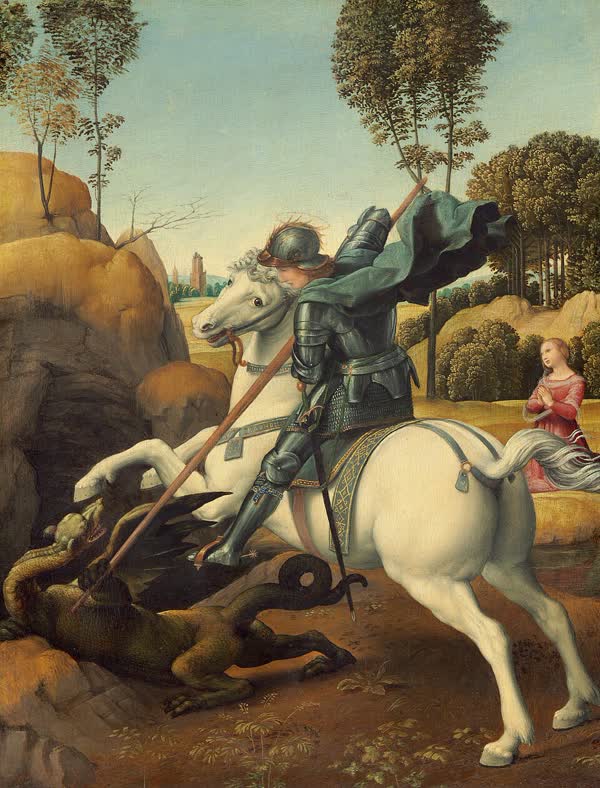
St. George
Roman soldier martyred under Diocletian for refusing to renounce Christ; later legend made him the dragon-slayer of chivalry.
Behind the famous legend stands a real and very early martyr. St. George suffered for the faith at or near Lydda in Palestine, probably in the persecution under Diocletian at the beginning of the fourth century. His cult is ancient and was widespread across both East and West long before the colorful stories grew up around him; churches were dedicated to him within a couple of centuries of his death, a sure sign that a genuine martyr lay behind the name.
What history can say is little more than that he was a soldier who refused to renounce Christ and was put to death after great sufferings, bearing his witness with such courage that he became, in the East especially, the very model of the soldier-saint — the Christian warrior who fought the truer battle against evil and gave his life rather than yield.
The beloved tale of the dragon belongs to the Middle Ages, many centuries later. In it, George rides to a city terrorized by a dragon that demands human victims, and arrives just as a princess is about to be sacrificed; making the sign of the cross, he wounds the beast and leads it captive, freeing the city, which is then converted. The dragon was understood as the devil, and George's victory as the triumph of faith — an image, in part, of the baptized Christian's battle with evil.
Carried home by crusaders who had seen his shrines in the East, his fame spread through Europe, and he was taken as a patron by soldiers, knights, and whole nations — above all England, whose red-on-white St. George's Cross became its flag. Stripped of legend, he remains what the early Church honored: a martyr who chose death over denial of Christ.
Long before the dragon legend, soldiers venerated him simply as a soldier brave enough to defy an emperor to his face.
Image: Raphael (Public domain), via Wikimedia Commons.
Source: newadvent.org/cathen/06453a.htm
Get a story like this every Sunday.
← Pope St. Soter · All saints · St. Fidelis of Sigmaringen →