Feast day: January 10
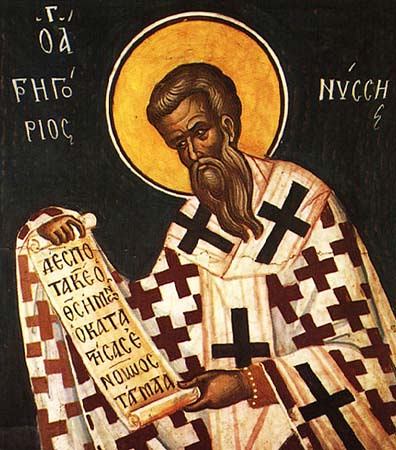
St. Gregory of Nyssa
Younger brother of Basil the Great and one of the Cappadocian Fathers whose precise language about the Trinity shaped the Nicene Creed we still recite.
Gregory was born about 335 into the remarkable holy family of Cappadocia that also gave the Church his elder brother St. Basil the Great, his brother St. Peter of Sebaste, and his sister St. Macrina the Younger, who largely formed them all. Unlike his brothers he was at first drawn to a secular career as a teacher of rhetoric, and even married, until the urging of his family and his own deepening faith led him to the service of the Church.
Made bishop of the small town of Nyssa, he proved less gifted than his brother Basil in the practical government and politics of the Church, and was for a time deposed and exiled by the Arians who then held imperial favor. But after Basil's death he came into his own, emerging as perhaps the most profound and original theological mind of the three great Cappadocian Fathers.
He played a decisive role at the Council of Constantinople in 381, which completed the Nicene Creed and affirmed the divinity of the Holy Spirit — so that much of what Christians confess each Sunday about the Trinity bears the mark of his thought. He wrote powerfully against the lingering Arian heresy and in defense of the full equality of the three divine Persons.
His deepest legacy is mystical. He taught that the soul's journey into God is an endless ascent — that because God is infinite, to find him is always to go on seeking him, rising 'from glory to glory' forever, so that even heaven is an unending discovery of a love without limit. Honored as a Father of the Church, he is one of its great contemplative theologians.
He helped finalize the Creed at the Council of Constantinople in 381 — much of what Christians say about the Holy Spirit each Sunday traces to his pen.
“Concepts create idols; only wonder grasps anything.”
— St. Gregory of Nyssa
Image: AnonymousUnknown author (Public domain), via Wikimedia Commons.
Source: newadvent.org/cathen/07016a.htm
Get a story like this every Sunday.
← St. Adrian of Canterbury · All saints · St. Theodosius the Cenobiarch →