Feast day: September 3
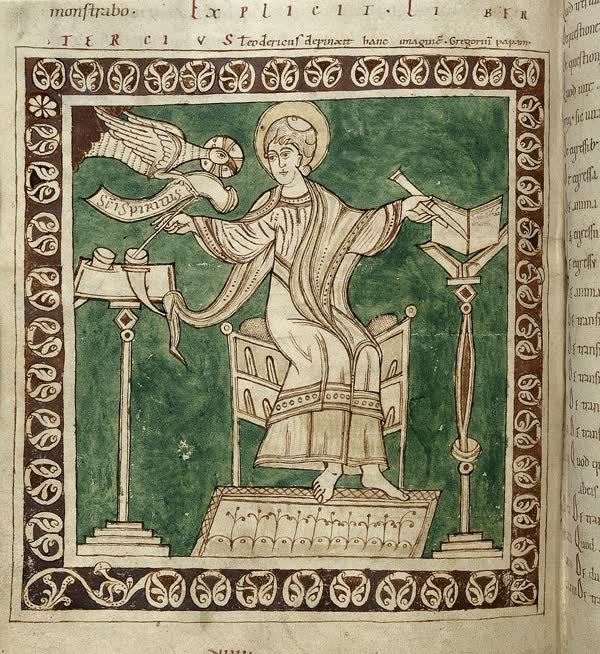
St. Gregory the Great
Roman prefect who sold his palaces, became a monk, then was dragged into the papacy — where he fed a starving city, sent missionaries to England, and shaped the liturgy.
Gregory was born about 540 into a wealthy and devout Roman family, in a city and an empire falling into ruin. He rose to be prefect of Rome, its highest civil office, but then renounced his wealth and rank, turned his family mansion into a monastery, and became a monk, longing for a life of contemplation. The Church, however, had other plans: he was drawn into its service as a deacon and papal envoy to Constantinople, and in 590, much against his will, he was elected pope.
He governed in a time of catastrophe — plague, famine, floods, and the Lombard armies threatening Rome — and rose to meet it all. With the imperial government collapsed, the pope became the practical ruler and protector of the city, organizing food and defense, ransoming captives, and negotiating with the invaders. He laid the foundations of the medieval papacy, yet called himself simply 'the servant of the servants of God,' a title popes have used ever since.
He was tireless for the spread of the faith. Famously moved by the sight of fair-haired English slaves in the Roman market — 'not Angles but angels,' he is said to have remarked — he sent the monk Augustine and his companions to convert the English, opening one of the great chapters of Christian history.
He reformed the Church's worship and is honored in the name of the 'Gregorian chant' that took shape under his influence, and his writings — the 'Pastoral Rule' on the care of souls, his homilies, and his 'Dialogues' — became textbooks of the Middle Ages. He died in 604 and is honored as a Father and one of the four great Latin Doctors of the Church.
Gregorian chant bears his name. So does the job description he wrote for popes: 'servant of the servants of God' — still used today.
“The proof of love is in the works.”
— St. Gregory the Great
Image: British Library (CC0), via Wikimedia Commons.
Source: newadvent.org/cathen/06780a.htm
Get a story like this every Sunday.
← The Martyrs of September 1792 · All saints · St. Rose of Viterbo →