Feast day: June 28
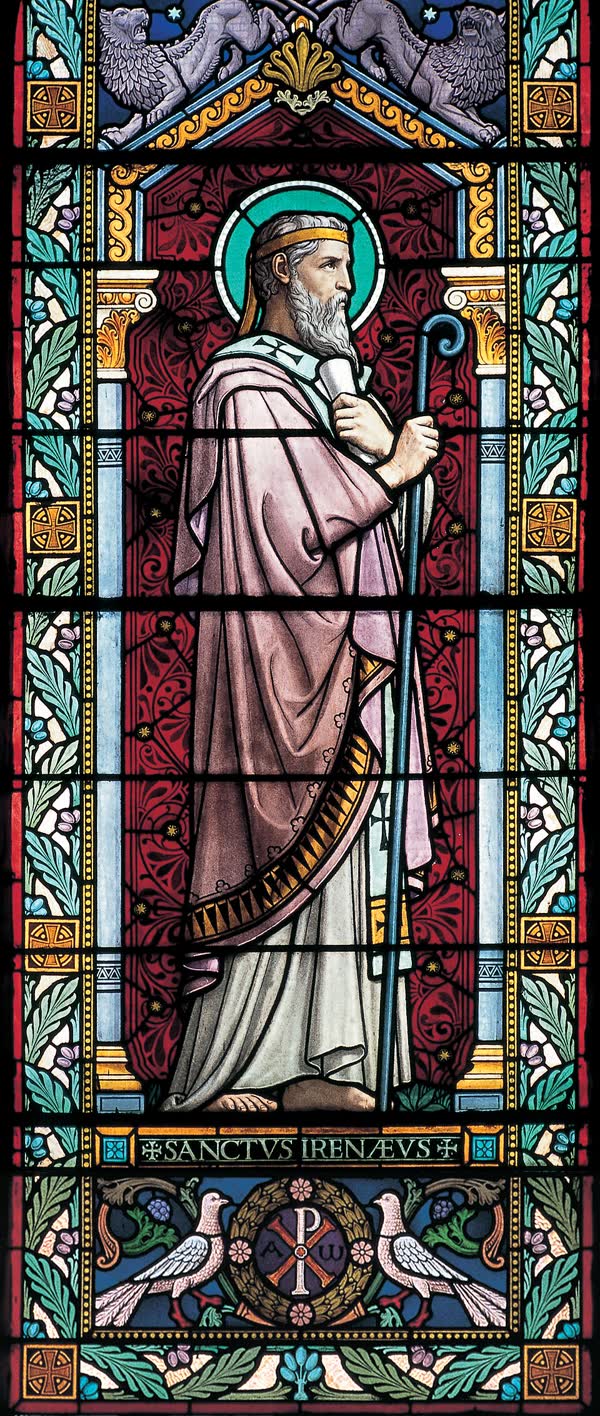
St. Irenaeus
Bishop of Lyon, taught by Polycarp who was taught by the Apostle John; his writings against Gnosticism defined orthodox Christianity.
Irenaeus was born about 130, probably at Smyrna in Asia Minor, and as a boy he heard the preaching of St. Polycarp — who had himself known the apostle John. This direct chain of memory, from John to Polycarp to Irenaeus, mattered immensely to him, for it meant the faith he held was the very faith handed down from the apostles, not something invented later. He carried that conviction west, becoming a priest and then bishop of Lyons in Gaul.
His great work, 'Against the Heresies,' was written to refute the Gnostics — teachers who claimed a secret, higher knowledge, despised the material world and the body, and split the God of creation from the God of redemption. Against them Irenaeus set out, patiently and at length, the public, handed-down faith of the Church, appealing to the Scriptures, the rule of faith, and the unbroken succession of bishops from the apostles as the guarantee of the truth.
He taught the great theme of 'recapitulation' — that Christ became what we are, passing through every stage of human life, to gather up and heal in himself all that Adam had ruined, so that, as he famously wrote, 'the glory of God is man fully alive, and the life of man is the vision of God.' His was a faith deeply rooted in the goodness of creation and the reality of the body that would rise again.
True to his name, which means 'peaceable,' he acted as a peacemaker, intervening to keep the peace between Rome and the churches of Asia over the date of Easter. By tradition he died a martyr about the year 202. Long honored as a Father of the Church, he was declared a Doctor of the Church in 2022, with the title 'Doctor of Unity.'
He's two handshakes from Jesus: Irenaeus learned from Polycarp, who learned from John, who leaned on Christ's chest at the Last Supper.
“The glory of God is man fully alive.”
— St. Irenaeus
Image: Lucien Bégule (Public domain), via Wikimedia Commons.
Source: newadvent.org/cathen/08130b.htm
Get a story like this every Sunday.
← St. Cyril of Alexandria · All saints · Sts. Peter & Paul →