Feast day: November 8
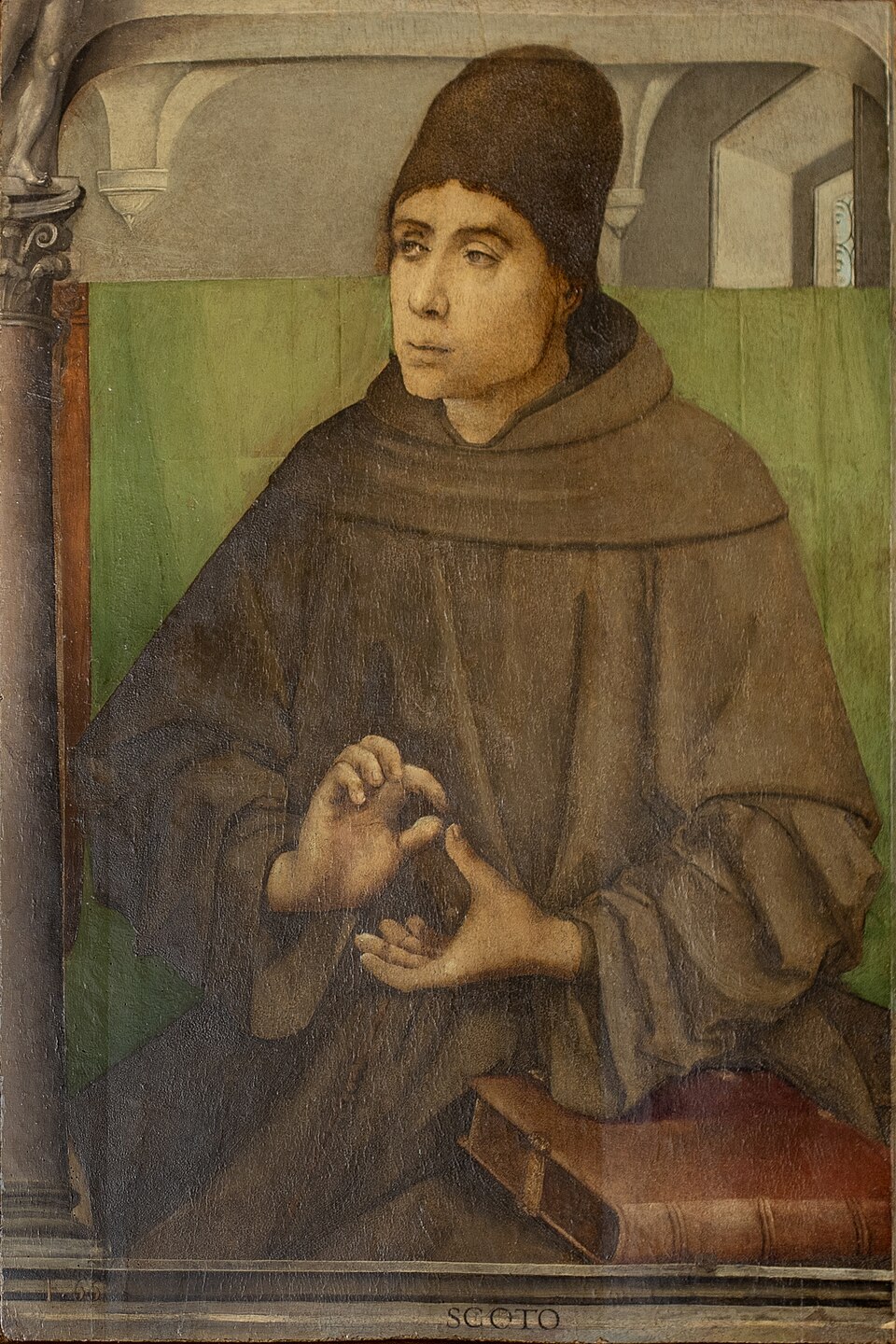
Bl. John Duns Scotus
A Scottish Franciscan philosopher of dazzling subtlety, called the 'Subtle Doctor,' whose arguments defended the Immaculate Conception of Mary centuries before it was defined.
John Duns Scotus, one of the greatest philosophers and theologians of the Middle Ages, was born about 1266, probably in the Scottish village of Duns from which he takes his surname. He entered the Franciscan Order, was ordained a priest, and studied and taught at the great universities of Oxford, Paris, and Cologne, where he died in 1308, still a relatively young man.
His mind was so penetrating and his distinctions so fine that he earned the title 'the Subtle Doctor.' Standing somewhat against the towering synthesis of his older contemporary St. Thomas Aquinas, Scotus developed a rich and original philosophy and theology of his own, emphasizing above all the absolute primacy and freedom of God's love, and the unique, irreducible value of each individual created thing.
His most celebrated contribution concerned the Immaculate Conception of the Virgin Mary. Many theologians had hesitated to affirm that Mary was preserved free from original sin, fearing it would detract from the universal need for Christ's redemption. Scotus offered the elegant solution that won the day: Mary was redeemed too — but in the most perfect way, by being preserved from sin in advance, in view of her Son's merits.
His thought shaped a whole school, the 'Scotists,' that flourished for centuries, and his defence of the Immaculate Conception helped prepare the Church's eventual definition of that doctrine. Long venerated, he was formally beatified by Pope John Paul II in 1993.
His careful reasoning won the long debate over Mary's Immaculate Conception — and his name, 'Dunse,' was unfairly twisted by opponents into the word 'dunce.'
Image: Justus van Gent / Pedro Berruguete (Public domain), via Wikimedia Commons.
Source: newadvent.org/cathen/05194a.htm
Get a story like this every Sunday.
← St. Willibrord · All saints · The Dedication of the Lateran Basilica →