Feast day: October 9
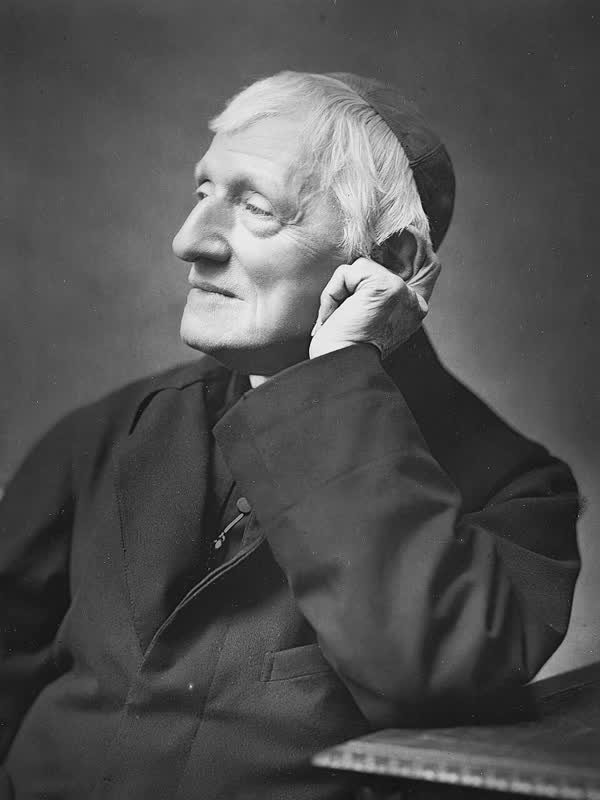
St. John Henry Newman
Oxford's most famous preacher, who followed his conscience out of the Church of England into Catholicism at enormous personal cost, becoming a cardinal and intellectual giant.
John Henry Newman was born in London in 1801 and became one of the most brilliant minds of nineteenth-century England — an Anglican priest, an Oxford scholar and fellow of Oriel College, and a preacher whose sermons at the university church moved a generation. In the 1830s he became a leader of the Oxford Movement, which sought to recall the Church of England to its ancient Catholic roots.
His study of the early Church, however, led him slowly and painfully toward a conclusion he had not sought: that the fullness of that ancient faith subsisted in the Roman Catholic Church. After years of agonized searching, and at enormous personal cost — the loss of his position, his friends, and his place in English society — he was received into the Catholic Church in 1845, the most famous English convert of his age.
As a Catholic he founded the Oratory in England, served as rector of a new Catholic university in Ireland, and wrote works that still shape Christian thought: the 'Apologia Pro Vita Sua,' the moving account of his conversion that won back the respect of a hostile nation; the 'Essay on the Development of Christian Doctrine'; 'The Idea of a University'; and the poem 'The Dream of Gerontius.' His hymn 'Lead, Kindly Light' is sung the world over.
He wrote profoundly on conscience, on the harmony of faith and reason, and on the role of the laity, anticipating much that the Church would later affirm. Made a cardinal by Pope Leo XIII in 1879, he took as his motto 'heart speaks to heart.' He died in 1890, and was canonized in 2019 — a guide for all who seek the truth wherever it may lead.
His conversion cost him friends, family, position, and reputation overnight. His motto: 'Heart speaks to heart.'
“To live is to change, and to be perfect is to have changed often.”
— St. John Henry Newman
Image: Herbert Rose Barraud (Public domain), via Wikimedia Commons.
Source: newadvent.org/cathen/10794a.htm
Get a story like this every Sunday.
← St. Pelagia the Penitent · All saints · St. Francis Borgia →