Feast day: June 26
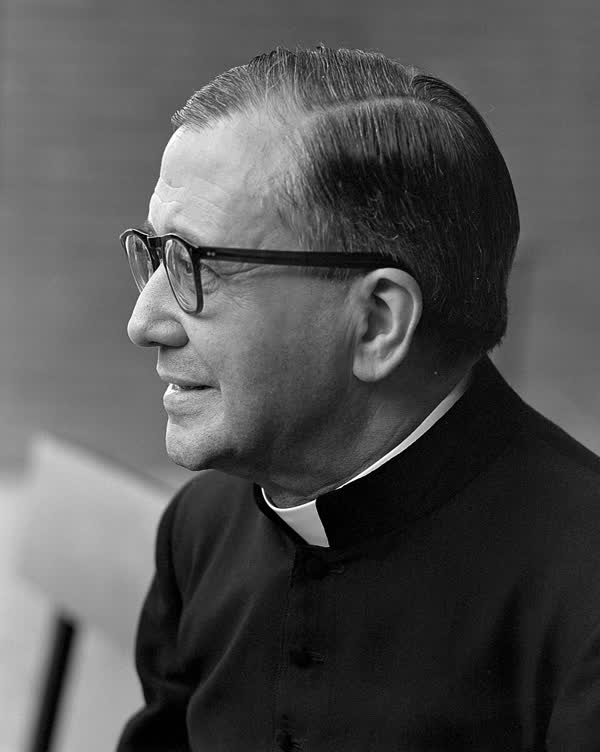
St. Josemaría Escrivá
Spanish priest who founded Opus Dei to teach that everyday work — done well and offered to God — is a path to sainthood.
Josemaría Escrivá was born in 1902 in Aragon, Spain, the son of a merchant whose business failed, and grew up amid family grief and hardship, losing several younger sisters in childhood. Sensing as a boy that God wanted something of him, he became a priest, and in 1928, while on retreat in Madrid, he experienced what he described as a clear vision of his life's mission.
That mission was a single, then-startling idea: that holiness is not reserved for priests and monks and nuns, but is the calling of every baptized Christian, to be reached not by fleeing ordinary life but in the very midst of it — in one's work, one's family, one's daily duties and friendships. Ordinary work, done well and offered to God, was itself to be a path to sanctity and a means of drawing others to Christ.
To live and spread this message he founded Opus Dei — 'the Work of God' — an organization chiefly of lay men and women who seek holiness in their secular professions and circumstances, without leaving the world. Through the upheavals of the Spanish Civil War, in which he was hunted, and through decades of growth and sometimes controversy, he guided it from Rome.
His little book of spiritual maxims, 'The Way,' was read by millions, and his insistence on the 'universal call to holiness' and the sanctifying value of everyday work anticipated a theme that the Second Vatican Council would place at the heart of its teaching. He died in Rome in 1975 and was canonized in 2002.
His core message in one line: you don't have to leave the world to become a saint; sanctify your desk, your kitchen, your commute.
“Great holiness consists in carrying out the little duties of each moment.”
— St. Josemaría Escrivá
Image: Oficina de Información de la Prelatura del Opus Dei en España (CC BY-SA 2.0), via Wikimedia Commons.
Source: vatican.va/news_services/liturgy/saints/ns_lit_doc_20021006_escriva_en.html
Get a story like this every Sunday.
← St. William of Vercelli · All saints · St. Cyril of Alexandria →