Feast day: December 9
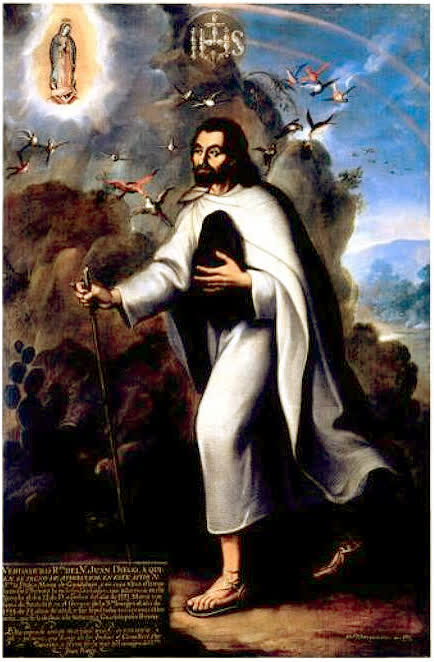
St. Juan Diego
Indigenous Mexican convert to whom Our Lady of Guadalupe appeared in 1531, leaving her image on his tilma — a cloak that should have decayed in 20 years and is still intact.
Juan Diego was born in 1474, an indigenous man of the Chichimeca people in the valley of Mexico, decades before the Spanish conquest, and bore the Nahuatl name Cuauhtlatoatzin, 'the eagle who speaks.' He was a man of humble station — a farmer and weaver of mats — and after the coming of the missionaries he and his wife became among the early native converts to the Christian faith, devout and earnest in their new belief.
In December 1531, as he walked to Mass before dawn, he encountered on the hill of Tepeyac a radiant young woman who spoke to him in his own language and revealed herself as the Mother of the true God. She entrusted to him a mission: to go to the bishop of Mexico City and ask that a church be built on that spot, where she might draw near to all the peoples of the land and show them her love.
The bishop was slow to believe a poor Indian's tale and asked for a sign. When Our Lady sent Juan Diego to gather roses blooming impossibly on the frozen hilltop and carry them in his cloak, the flowers spilled out before the bishop to reveal her image miraculously imprinted on the rough cloth — the image of Our Lady of Guadalupe that is venerated to this day.
For the rest of his life Juan Diego lived in a small room beside the first chapel, caring for the shrine and telling all who came of the Lady's message, until his death in 1548. Through him, in a few short years, millions of the native peoples of Mexico embraced the faith. He was canonized in 2002, the first indigenous saint of the Americas, and is honored as a model of humility and of the dignity of the lowly.
His cactus-fiber tilma, with its scientifically unexplained image, still hangs in Mexico City — nearly 500 years past its expected lifespan, seen by 20 million pilgrims a year.
Image: Miguel Cabrera (Public domain), via Wikimedia Commons.
Source: vatican.va/news_services/liturgy/saints/ns_lit_doc_20020731_juan-diego_en.html
Get a story like this every Sunday.