Feast day: March 21
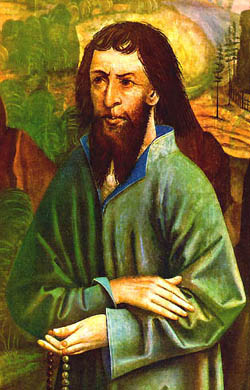
St. Nicholas of Flüe
A Swiss farmer, soldier, and judge who, with his wife's consent, left his family and farm to live as a hermit, and whose counsel later kept the Swiss confederation from civil war.
Nicholas of Flüe — known to the Swiss as Brother Klaus — was born in 1417 in the canton of Unterwalden: a farmer, soldier, magistrate, and the father of ten children. Respected for his honesty and good sense, he served as a councillor and judge and even commanded troops in the cantonal wars, always with a reputation for restraint and mercy.
At the age of fifty, with the consent of his wife and family, he answered a long-felt call to leave everything for God. He set out as a pilgrim, then settled close to home as a hermit in a narrow valley, the Ranft, living in extreme austerity. His contemporaries — and official investigators of the time — testified that for nearly twenty years he took virtually no food, living, it was said, on the Eucharist alone.
People of every rank, including statesmen, came to the unlettered hermit for counsel. His greatest moment came in 1481, when the Swiss confederation, newly victorious, fell to quarrelling at the Diet of Stans and civil war seemed certain. A message of advice from Brother Klaus, carried to the delegates, reconciled them overnight and held the young confederation together.
He died in 1487. Long venerated as the peacemaker and father of his country, he was canonized in 1947 and is honoured as the patron saint of Switzerland.
By tradition he ate nothing but the Eucharist for nineteen years, and his single intervention in 1481 held the young Swiss nation together.
Image: User Geogre on en.wikipedia (Public domain), via Wikimedia Commons.
Source: newadvent.org/cathen/11062a.htm
Get a story like this every Sunday.