Feast day: May 9
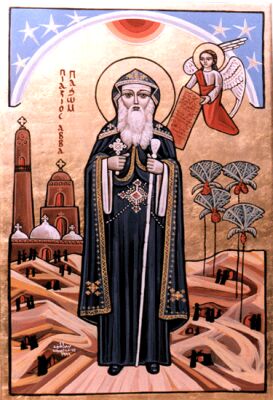
St. Pachomius the Great
A former Roman soldier in Egypt who, after the example of hermits, gathered monks into the first organized community under a written rule — the father of communal monasticism.
Pachomius was born about 292 in Upper Egypt of pagan parents and, as a young man, was conscripted into the Roman army. Imprisoned with other recruits, he was astonished by the kindness shown to the soldiers by local Christians, who brought them food and comfort; on his release he sought instruction, was baptized, and withdrew to the desert to live as a hermit under an old ascetic named Palaemon.
The monastic movement was then in its infancy. St. Anthony and others had shown the way as solitary hermits, but Pachomius received what he believed was a divine call to something new: to gather monks together into an organized community. About the year 320 he founded his first monastery at Tabennisi on the Nile.
His great innovation was the 'cenobitic' life — monks living together under a common roof, a common rule, and a single superior, sharing work, prayer, meals, and obedience. He wrote the first true monastic Rule, balancing prayer with manual labour and ordering every detail of the common life. The idea spread with astonishing speed.
By the time of his death in 346 he governed a federation of nine monasteries of men and two of women, numbering thousands of monks. As the father of communal monasticism, Pachomius shaped a form of religious life that, through later founders like St. Benedict, would spread across the whole world.
Before him, monks lived alone; he invented the monastery — common life, common work, and a daily rule — the pattern every religious order still follows.
Image: artist unknown (Public domain), via Wikimedia Commons.
Source: newadvent.org/cathen/11381a.htm
Get a story like this every Sunday.
← The Apparition of St. Michael the Archangel · All saints · St. Damien of Molokai →