Feast day: February 10
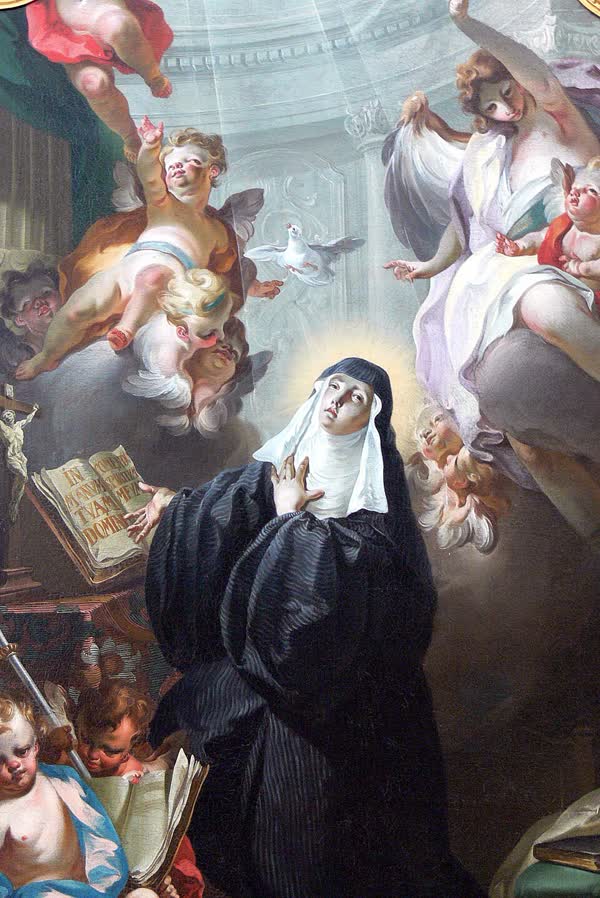
St. Scholastica
Twin sister of St. Benedict and first Benedictine nun; their yearly visits ended with a famous storm she prayed down from heaven.
Scholastica was the sister — by tradition the twin — of St. Benedict, the father of Western monasticism, and like him was drawn from childhood to give herself wholly to God. As Benedict gathered monks at Monte Cassino, Scholastica led a community of consecrated women not far away, and is honored as the first Benedictine nun and the mother of all the women who would follow that great rule.
Almost everything we know of her comes from a single, tender story told by St. Gregory the Great. Brother and sister, both vowed to God, met only once a year, at a house between their monasteries, to spend a day speaking of holy things. At their last such meeting, as evening came, Scholastica begged her brother to stay through the night so they might go on talking of the joys of heaven.
Benedict refused, bound by his own rule not to spend a night away from the monastery. So Scholastica bowed her head in prayer over the table, and at once a violent storm broke — so sudden and so fierce that Benedict could not set foot outside. 'God forgive you, sister,' he said; 'what have you done?' She answered simply, 'I asked you, and you would not listen; so I asked my God, and he heard me.'
They passed the whole night in holy conversation, and it was their last; three days later, from his monastery, Benedict saw his sister's soul rise to heaven in the form of a dove. He had her body brought and laid in the tomb he had prepared for himself, so that, as Gregory wrote, those whose minds had always been united in God were not separated even in the grave. She is a patron of Benedictine nuns and is invoked against storms.
When Benedict tried to leave her last visit early, she prayed — and a thunderstorm trapped him there. 'I asked you, and you would not listen. So I asked my God.'
“I asked you, and you would not listen; so I asked my God, and He did listen.”
— St. Scholastica
Image: Johann Baptist Wenzel Bergl (CC BY-SA 3.0), via Wikimedia Commons.
Source: newadvent.org/cathen/02467b.htm
Get a story like this every Sunday.