Feast day: July 3
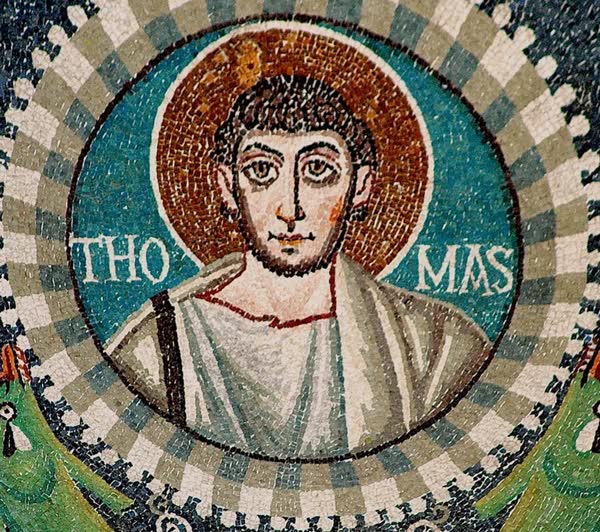
St. Thomas the Apostle
The apostle who doubted the Resurrection until he touched the wounds — then carried the Gospel farther than almost anyone, reaching India.
Thomas, called Didymus ('the Twin'), was one of the Twelve, remembered above all for a moment of doubt that became a profession of faith. When Jesus resolved to return to Judea where his enemies sought to kill him, it was Thomas who said to the others, with brave if gloomy loyalty, 'Let us also go, that we may die with him' — and at the Last Supper it was his honest question, 'Lord, we do not know where you are going; how can we know the way?' that drew from Jesus the answer, 'I am the way, and the truth, and the life.'
He was not with the others when the risen Christ first appeared, and he refused to believe on their word alone: 'Unless I see the mark of the nails in his hands, and put my finger where the nails were, I will not believe.' A week later Jesus came again and offered Thomas his wounds — and Thomas, all doubt swept away, fell down with the greatest confession of faith in the Gospels: 'My Lord and my God!'
Jesus answered with a blessing meant for every believer since: 'Blessed are those who have not seen and yet have believed.' The honest doubter who became a witness to the divinity of Christ has comforted countless Christians who struggle to believe.
By a strong and ancient tradition, Thomas carried the Gospel farthest of all the apostles — east to India, where to this day the 'St. Thomas Christians' of the Malabar coast trace their faith to him. He is said to have been martyred with a spear near Mylapore, and is honored as the patron of India and, because of another tradition that he built a palace for a king, of architects and builders.
The 'Thomas Christians' of India trace their church to his preaching in 52 AD — older than Christianity in most of Europe.
“My Lord and my God!”
— St. Thomas the Apostle
Image: Richard Mortel (CC BY 2.0), via Wikimedia Commons.
Source: newadvent.org/cathen/14658b.htm
Get a story like this every Sunday.
← St. Otto of Bamberg · All saints · St. Elizabeth of Portugal →