Feast day: December 13
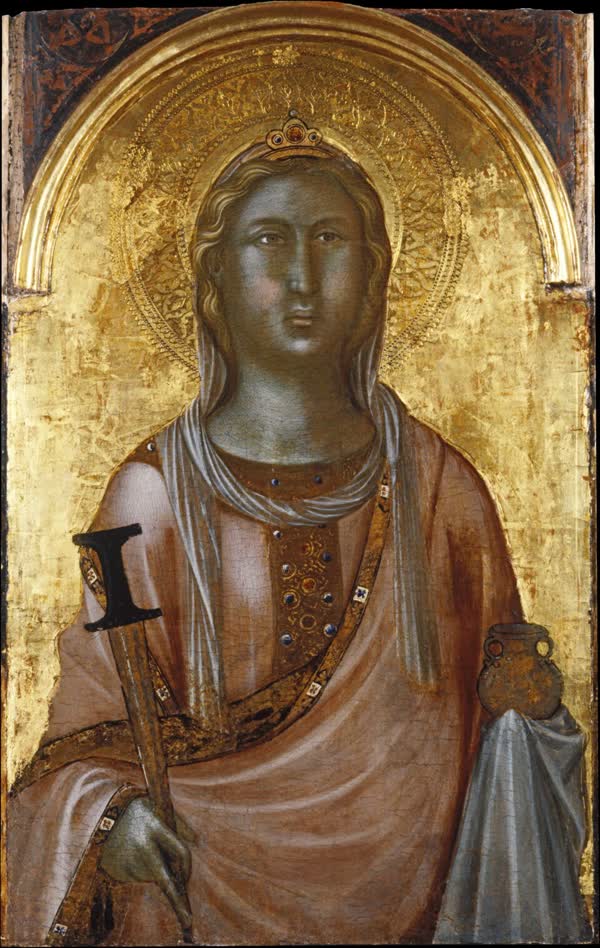
St. Lucy
Sicilian martyr under Diocletian whose name means 'light'; her feast once fell on the winter solstice, making her the saint of light in deepest darkness.
Lucy was a young Christian woman of Syracuse in Sicily, martyred in the persecution of Diocletian about the year 304. Her veneration is very ancient and certain — she is one of the few women named in the Canon of the Mass — even if the details of her 'Acts' are legendary. By that tradition she came of a wealthy family and, in thanksgiving for her mother's cure at the tomb of St. Agatha, secretly vowed her virginity to God and resolved to give her dowry to the poor.
The young man to whom she had been unwillingly betrothed, enraged at losing both his bride and her fortune to the poor, denounced her as a Christian to the governor. Condemned, she was, the story says, miraculously immovable when they tried to drag her away — not even teams of oxen could shift her — and so she was put to death where she stood, faithful to her Lord.
Her name means 'light,' from the Latin 'lux,' and around that meaning a beautiful devotion grew up, especially because her feast on December 13 fell, in the old calendar, near the shortest, darkest days of the year. She became the saint of light shining in the darkness, invoked by those with diseases of the eyes and as the patron of the blind.
In the Scandinavian lands her feast became a great festival of light in the depth of winter, where to this day a girl crowned with candles, dressed in white, leads the household in song as 'Santa Lucia' — carrying light into the darkest night, as the martyr carried the light of faith into the darkness of persecution.
Sixteen centuries later, Scandinavia — about as far from Sicily as Europe gets — still crowns girls with candles every December 13 for a Sicilian martyr.
Image: Niccolò di Segna (Public domain), via Wikimedia Commons.
Source: newadvent.org/cathen/09414a.htm
Get a story like this every Sunday.
← Our Lady of Guadalupe · All saints · St. John of the Cross →