Feast day: December 6
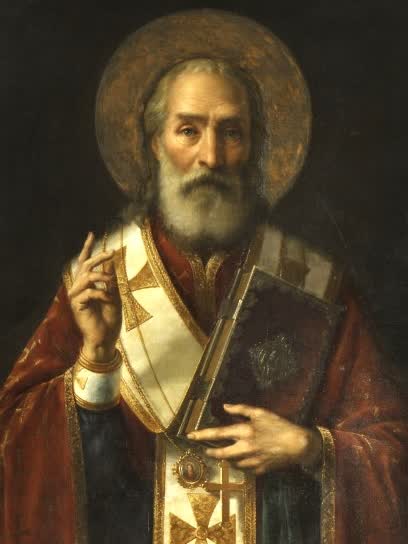
St. Nicholas
Bishop of Myra famed for secret generosity — gold tossed through a poor man's window by night saved three daughters from destitution. Yes, the real Santa Claus.
Nicholas was bishop of Myra, a port city in Lycia in what is now Turkey, in the fourth century. Almost nothing about him can be established with certainty beyond that he was a much-loved bishop venerated very early and very widely in both the Greek and Latin Churches; but around that slender fact gathered a wealth of beloved tradition that made him one of the most popular saints of all time.
By tradition he was imprisoned during the persecutions before Constantine and lived to attend, some accounts say, the great Council of Nicaea. But the stories that endeared him to the people were stories of secret generosity — above all that of a poor man with three daughters who had no dowries and faced ruin, to whom Nicholas, by night, tossed bags of gold through the window, saving them from disgrace without ever revealing himself.
That tale of hidden gifts, given for love and not for thanks, is the root of everything that followed. He became the patron of children, sailors, merchants, and the poor, and across Germany, the Netherlands, and Switzerland it became the custom for him to bring presents secretly to children on the eve of his feast, December 6.
Carried by Dutch settlers to America, 'Sinterklaas' was transformed into Santa Claus — so that the jovial gift-bringer of the modern Christmas descends, by a long and tangled road, from a fourth-century bishop famous for giving in secret. His relics, carried to Bari in Italy in 1087, still draw pilgrims, and he remains one of the best-loved of all the saints.
The historical Nicholas attended the Council of Nicaea, endured prison under Diocletian, and gave in secret. Seventeen centuries of gift-giving trace to one bishop's hidden charity.
Image: Jaroslav Čermák (Public domain), via Wikimedia Commons.
Source: newadvent.org/cathen/11063b.htm
Get a story like this every Sunday.