Feast day: December 5
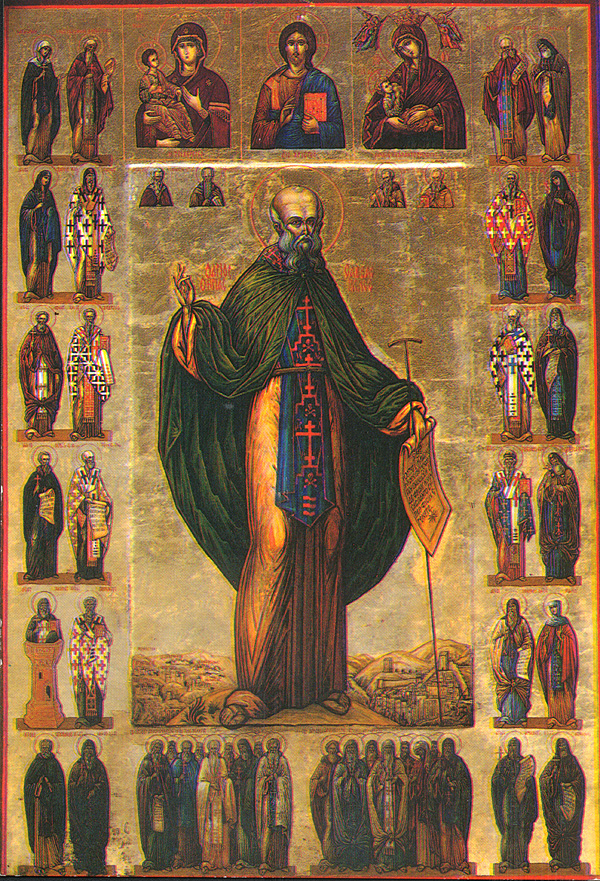
St. Sabbas the Sanctified
One of the great founders of monasticism in the Judean desert, whose 'Great Lavra' near Bethlehem still survives after fifteen centuries, and whose monastic rule shaped Eastern worship.
Sabas — called 'the Sanctified' — was one of the great founders of monasticism in the Holy Land, born in Cappadocia about 439 and drawn as a boy to the monastic life. As a young man he made his way to Palestine, where he placed himself under the desert father St. Euthymius and then withdrew into the wild ravines of the Judean wilderness to live as a hermit.
Like his contemporary St. Theodosius, he attracted disciples who would not leave him alone, and about 483 he organized them into a 'laura' — a colony of hermits living in separate caves and cells scattered along a cliff above the Kidron valley, gathering at the weekend for common worship. This was the Great Laura, today the monastery of Mar Saba, inhabited by monks almost without interruption ever since.
Reluctantly ordained a priest, Sabas was made by the patriarch of Jerusalem the head of all the hermits of Palestine, while his friend Theodosius governed the communal monasteries. He founded several more monasteries and a hospice, and laboured to spread the laura form of monastic life.
A staunch defender of orthodoxy, he twice journeyed in old age to Constantinople to plead with the emperor on behalf of the faith and the people of Palestine. He died at his laura in 532, well over ninety years old. His monastery became a renowned centre of learning — home, later, to St. John Damascene — and shaped the liturgy of the Eastern Church.
The monastery he founded, Mar Saba, is one of the oldest inhabited monasteries on earth — monks have prayed there without a break for over 1,500 years.
Image: The original uploader was Alekjds at English Wikipedia. (Public domain), via Wikimedia Commons.
Source: newadvent.org/cathen/13286b.htm
Get a story like this every Sunday.